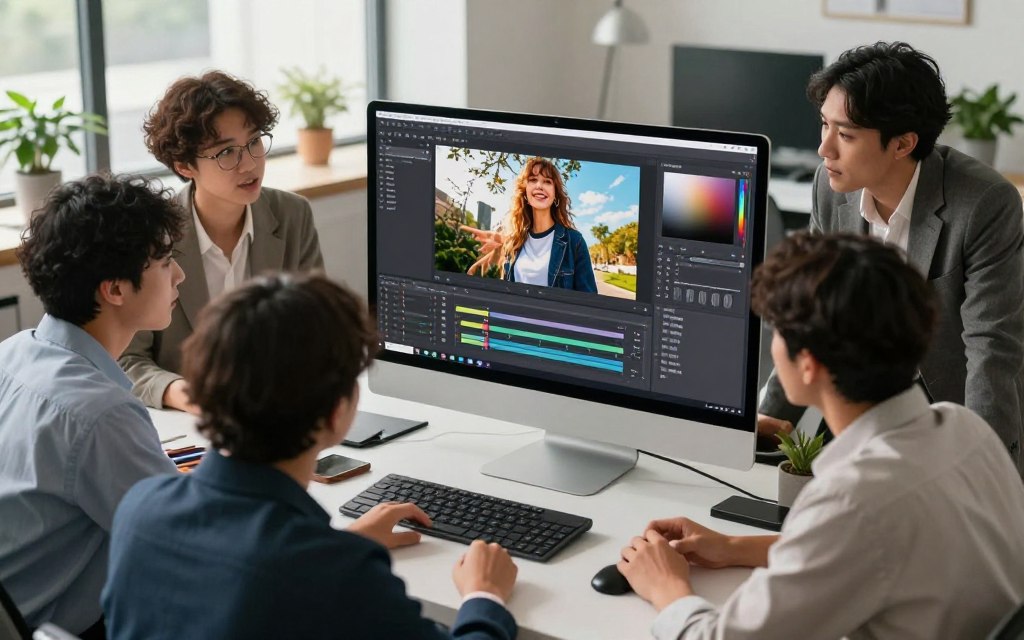

The world of photography and visual content is changing fast. Artificial intelligence is now key in editing software. It’s changing how we edit our pictures.
This tech is making editing easier for everyone. Tasks that took hours to learn can now be done in minutes. It helps both professional photographers and social media managers to improve their work easily.
If you want to enhance images and make your work easier, these tools are vital. They handle the hard parts, so you can focus on making your pictures great.
Transforming Visuals: The Power of AI in Editing
Artificial intelligence is changing how we design visuals. It goes beyond just changing pixels. Now, AI can understand the context of a scene, not just its parts.
This is a big step forward from simple filters. AI tools can now look at the whole scene. They understand how objects, lighting, and textures work together.
AI’s smart edits are a game-changer. For example, removing an object no longer leaves a blank space. Instead, AI uses generative fill to create new background content that fits perfectly. It can also improve skies, sharpen details, and change compositions with just a text prompt.
Editing has changed from a hard task to a creative conversation. Now, people can tell AI what they want, and it does the rest. This turns hours of work into moments of inspiration.
The table below shows how editing has changed:
| Aspect | Traditional Editing Workflow | AI-Powered Workflow |
|---|---|---|
| Skill Required | Advanced software knowledge | Creative vision & descriptive prompts |
| Time Investment | Hours for complex edits | Minutes or seconds |
| Primary Action | Manual pixel manipulation | Guiding the AI’s interpretation |
| Result Consistency | Varies with user skill level | Consistently high-quality output |
Emma Wilson, a freelance graphic designer, has seen a huge time saving. “What used to take me an afternoon now takes under a minute. I can respond to client feedback quickly,” she says.
The barrier to professional-looking results has completely vanished. I’m a blogger, not a photographer, but my visuals now look like they were done by a pro. It’s empowering.
Sophia Lin, a marketing professional, sees the impact on quality and scale. “Our team produces a lot of visual content. AI tools ensure our brand looks consistent and polished, without needing a specialist for every task,” she explains.
AI in editing is empowering. It makes creating high-quality visuals accessible to more people. Now, they can focus on their message and creativity, not just technical skills.
What is an AI Image Remaker?
An AI image remaker is a software that uses machine learning to change images based on what you tell it. It’s a big change from just moving pixels around. This tool can even create new images from scratch.
Old editors need you to pick and choose what to change. But an AI remaker gets what you want. Just give it a text prompt or click a button. Then, it uses complex algorithms to change the image for you.
This magic happens thanks to generative AI and deep neural networks. These systems have learned from lots of images. They can fill in missing parts, remove things, or change an image’s look in a way that looks real.
Features like neural filters show how good it is. They make changes that look like they were done by a pro. You can smooth out skin, change styles, or adjust depth of field with just a few clicks.
This changes professional editing a lot. Tasks that took hours can now be done in minutes. It doesn’t replace the need for skill, but it helps a lot. Now, creatives have more time to think and work with clients.
| Aspect | AI Image Remaker | Traditional Editing Software |
|---|---|---|
| Editing Method | Intelligent, algorithmic analysis and generation. | Manual tool-based manipulation of pixels. |
| Learning Capability | Uses trained models to understand content and context. | Relies on fixed algorithms and user-preset actions. |
| Primary Input | Text prompts, one-click actions, automated suggestions. | Direct user input with brushes, masks, and sliders. |
| Output Nature | Can create new image elements and radically alter composition. | Primarily modifies existing visual data within the frame. |
| Skill Requirement | Lower barrier to entry for complex edits; enhances expert workflow. | High degree of technical skill needed for advanced results. |
In short, an AI image remaker is a tool that makes creating images easy. It turns ideas into pictures through a mix of human input and machine smarts. This makes professional editing easier and more creative.
Key Benefits of Using an AI Image Remaker
AI image remakers cut editing time in half and help beginners. They change how we make and improve visual content. They make top-quality visuals available to more people.
Editing time drops dramatically. Old photo editing was hard and slow. AI tools do complex tasks fast, saving hours.
Now, anyone can make great images without Photoshop skills. Magic edit features let you describe changes, and AI does the rest. This makes it easy for everyone.
AI edits are always the same quality. This builds trust. You get perfect edits every time, no matter how many images.
AI makes complex edits simple. Tasks that experts used to do are now easy for anyone.
- Background Replacement: Swap dull backdrops for amazing ones easily.
- Object Generation & Removal: Remove unwanted items or add new ones that fit perfectly.
- Quality Enhancement: Make low-quality images better or fix old photos.
Advanced AI models power these features. They understand images in a new way, making editing smarter.
Costs have changed too. Remaker AI uses credits, not subscriptions. This means you only pay for what you use. It’s flexible and affordable.
This tech makes high-quality visuals for everyone. You can make amazing social media graphics and more. It’s not just for pros anymore. Now, anyone can tell stories with images.
Essential Features to Consider in a Tool
When choosing an AI image remaker, look beyond the marketing. The real value lies in its core features. Knowing what to look for makes choosing easier.
Choose tools that offer both creative freedom and technical fixes. The right mix saves time and improves your image quality.

- High-Quality Upscaling: A top-notch image upscaler is essential. It enlarges photos without losing detail. This means you can use smaller images for bigger prints or displays.
- Precision Editing Tools: Tools like ‘Magic Eraser’ and ‘Background Remover’ are very useful. They remove objects and backgrounds quickly and accurately, saving you time.
- Intelligent Photo Restoration: For fixing old or damaged photos, you need photo restoration AI. It should fix cracks, scratches, and fading while keeping the photo’s original feel.
- Portrait-Specific Enhancements: Tools that enhance portraits automatically are great. They can smooth skin, brighten eyes, and adjust lighting for a professional look. The best ones make subtle, natural changes.
- Efficiency through Batch Processing: If you work on many images, batch processing is a huge time-saver. It applies the same changes to all images at once, which is vital for professionals.
The best tool gives you a great starting point and the control to make it your own.
Technical compatibility is also important. Support for RAW files lets you work with high-quality images from your camera. Look for platforms that offer both automated smarts and customisation options.
Features like sliders for adjustments, manual brush tools, and control over AI intensity are key. They let you guide the process. This mix of automated power and user control is what makes a tool professional-grade.
By focusing on these essential features, you invest in a tool that grows with you. It will consistently deliver top-notch results.
Comprehensive AI Image Remakers for All Tasks
Adobe Photoshop and Canva show how AI helps both pros and hobbyists. These tools offer a wide range of smart features. They handle simple edits and complex tasks in one place.
This means you don’t need to use many apps. Whether you’re fixing a photo or making social media graphics, these tools make it easier. Let’s look at the top options.
Adobe Photoshop (Generative Fill & Neural Filters)
Adobe Photoshop has become a powerhouse with AI. It’s more than just editing pixels. Its AI tools, like Generative Fill and Neural Filters, bring new levels of detail and precision.
Overview
Photoshop is the top choice for serious photographers and artists. Its AI is built into its powerful workspace. This lets you make edits that understand your image’s content.
The software uses AI to analyze scenes and objects. It then suggests or makes enhancements that look natural and professional.
Pros
- Unmatched depth and control over every editing parameter.
- Seamless integration of AI into a vast, established toolkit.
- Superior output quality suitable for commercial print and high-resolution media.
- Continuous updates with new AI features from Adobe’s Sensei platform.
Cons
- Requires a subscription, which can be costly for hobbyists.
- Steep learning curve for beginners.
- Can be resource-intensive, needing a powerful computer.
Key Features
- Generative Fill: Add, remove, or expand content using text prompts.
- Neural Filters: Apply complex effects like skin smoothing or style transfer instantly.
- Advanced colour correction and grading tools powered by AI analysis.
- Intelligent noise reduction that preserves fine detail.
- Sky Replacement and Select Subject tools for rapid, accurate masking.
Canva (Magic Edit & AI Photo Effects)
Canva is all about ease and speed. It adds AI features to its simple design workflow. It’s great for marketers, entrepreneurs, and social media creators who need quick, good-looking images.
Overview
Canva makes editing easy with its drag-and-drop tools. Its AI features are designed for quick, easy use. You don’t need design experience to get great results.
The platform works mainly in the cloud, so you can use it from anywhere. It’s all about making creating content for business and social media easier.
Pros
- Extremely intuitive and beginner-friendly interface.
- Offers a robust free plan with many free AI tools included.
- Huge library of templates, fonts, and design elements.
- Excellent for team collaboration and brand kit management.
Cons
- Less granular control compared to professional desktop software.
- Advanced AI features often require a Pro subscription.
- Output may lack the ultra-fine detail needed for large-format printing.
Key Features
- Magic Edit: Use text prompts to edit specific parts of an image.
- Background Remover: Instantly delete and replace backgrounds with one click.
- AI Photo Effects: Apply artistic filters and enhancements automatically.
- Magic Design: Generate entire design drafts from a simple idea.
- Brand Voice integration: Maintain consistent tone across all created content.
For those looking to master prompt-based editing, exploring specific AI photo editing prompts can significantly improve your results in tools like Canva’s Magic Edit.
Specialist Tools for Restoration and Enhancement
Photographers and archivists find magic in AI tools that revive damaged images. These tools use deep learning to fix lost visual details. They make old, low-quality images look new again.
These tools handle complex tasks like noise reduction and colour correction. They do this automatically, saving time and effort. We’ll look at two top platforms in this field.
Topaz Labs Photo AI
Overview
Topaz Labs Photo AI is a smart tool for image quality control. It works as a standalone app or plug-in. It uses AI to find and fix image flaws, making expert-level enhancements easy.
Pros
- It automatically sharpens, denoises, and upscales images.
- It’s great for batch processing large photo sets.
- It edits images without changing the original data.
- It can be used with popular software like Adobe Photoshop.
Cons
- It costs a lot, either through subscription or one-time purchase.
- It might lack manual control for some users.
- It needs a lot of computer power for high-resolution images.
Key Features
- Automatic Subject Detection: Finds faces, landscapes, and more to apply the best corrections.
- Integrated Quality Pipeline: Combines denoising, sharpening, and upscaling in one step.
- Batch Processing: Enhances hundreds of images at once, saving time.
- Detail Recovery: Uses special models to bring back clear details from blurry images.
VanceAI Photo Restorer
Overview
VanceAI Photo Restorer focuses on fixing old, damaged photos. It uses AI to remove scratches, spots, and restore colours. It’s easy to use, making complex restoration simple.
Pros
- It’s great at removing physical damage from scanned photos.
- It’s easy to use, with no software to install.
- It processes images quickly.
- It includes basic style transfer and colourisation features.
Cons
- It needs a constant internet connection.
- Advanced features and large use require a paid plan.
- It might struggle with very low-resolution or badly damaged images.
Key Features
- One-Click Restoration: Upload a photo, and the AI fixes common damage automatically.
- Old Photo Colourisation: Adds natural colours to black-and-white or sepia images.
- AI Photo Enhancer Core: Improves clarity and image quality through colour correction and detail enhancement.
- Creative Style Transfer: Applies artistic effects, showing its flexibility beyond restoration.
AI-Powered Solutions for Portrait Perfection
Getting perfect portraits is easier now, thanks to AI. These tools do more than just adjust photos. They understand faces, skin, and lighting.
This means you can make small changes or big creative changes. Whether you’re a pro or just for fun, these AI editors can make your portraits better.
Luminar Neo
Overview
Luminar Neo is a top AI photo editor for photographers. It’s great for portrait retouching and has smart tools for easy edits. It works well for both people and product photography.
Sophia Lin, a commercial photographer, loves it for product images. She says,
“The AI tools in Luminar Neo streamlined my workflow for e-commerce shoots, delivering magazine-quality results much faster.”
Pros
- Powerful and easy AI skin tools.
- Great for portraits and landscapes.
- Amazing AI sky replacement and effects.
- One-click fixes that look natural.
Cons
- It costs a lot over time.
- It’s got lots of features, so it’s hard for beginners.
- It uses a lot of computer resources.
Key Features
Portrait work is where Luminar Neo shines. The Skin AI tool smooths skin but keeps details like pores and hair.
Eye AI makes eyes brighter and more appealing. Face AI lets you shape facial features. And Atmosphere AI adds fog, mist, or sun rays.
PortraitAI
Overview
PortraitAI is all about artistic styles for portraits. It uses creative AI to turn photos into paintings by famous artists.
It’s perfect for those who want unique, artistic portraits fast. Great for social media or artistic projects.
Pros
- Creates unique, artistic portraits in seconds.
- Easy to use with a simple interface.
- Offers many art styles, old and new.
- No need to know a lot about photo editing software.
Cons
- Not for subtle, realistic retouching.
- You can’t control the style too much.
- Results are very stylised, not for all uses.
Key Features
PortraitAI’s main feature is its style transfer engine. Upload a portrait, and it reimagines it in many styles.
It also has basic tools to sharpen and improve contrast before applying the style. This makes sure the image is ready for the transformation.
| Feature | Luminar Neo | PortraitAI |
|---|---|---|
| Primary Use Case | Professional portrait & product photography retouching | Creative artistic styling for portraits |
| Core AI Strength | Realistic enhancement (skin, eyes, atmosphere) | Artistic style transfer and reinterpretation |
| Skill Level Required | Intermediate to Advanced | Beginner to Intermediate |
| Pricing Model | Subscription | Credit packs or subscription |
| Best For | Photographers needing precise, natural edits | Creatives and individuals seeking unique artistic portraits |
Creative and Experimental AI Image Platforms
Art and technology meet in special AI tools for creativity and style change. These platforms go beyond just fixing photos. They let users make new images, apply detailed styles, and explore AI’s creative limits.
Runway ML
Runway ML leads in creative AI research. It’s a toolkit for artists, filmmakers, and developers. It offers advanced models for making images and videos.
Overview
Starting from research, Runway ML makes complex AI easy to use. It lets users edit videos with AI, make images from text, and use style transfer without coding.
Pros
- It has a huge library of AI models for creative tasks.
- It’s great for video editing and synthesis, a rare feature.
- It gets new AI features regularly from research.
- It helps teams work together and manage projects.
Cons
- Its advanced features cost a lot, not good for hobbyists.
- It has many tools, making it hard for beginners to learn.
- It needs a fast internet for best performance.
Key Features
Its strength is in tools like Gen-1 for video, Inpainting for edits, and style transfer algorithms. It also lets users train custom models.

Deep Dream Generator
Deep Dream Generator is known for its psychedelic images. It’s a starting point for many in AI art.
Overview
This platform uses a technique from Google’s DeepDream. Users can upload photos and apply artistic styles. It creates surreal images easily.
Pros
- It’s easy to use, no AI knowledge needed.
- It has a unique style that’s hard to find elsewhere.
- It has a lively community for sharing and remixing.
- It offers a free version for trying before paying.
Cons
- The results can be unpredictable, less control than other tools.
- The dream style might not fit all projects or needs.
- More features and high-resolution outputs need a subscription.
Key Features
It has more than dream filters, like style transfer for painting images in another style. It also has text-to-image and sliders for adjusting effects.
Selecting the Ideal AI Image Remaker for You
Finding the right AI image remaker is not just about power. It’s about matching its features to your needs. With many options, from all-in-one suites to specialist platforms, a careful approach is key. This guide will help you choose the best one.
First, think about your skill level. Are you a beginner looking for easy edits for social media? Or do you need advanced tools for professional editing? Canva is great for beginners, while Adobe Photoshop is for experts.
Then, decide how you plan to use it. This is the most important step. Your main task will show which tool’s features are most useful.
For fixing photos, Topaz Labs Photo AI is top-notch. Luminar Neo is best for portrait retouching. Canva is perfect for quick visual content for marketing. Runway ML is great for artistic play.
Also, think about your budget. Decide if a subscription or credits fit your use better.
| Pricing Model | Best For | Key Consideration |
|---|---|---|
| Monthly/Annual Subscription | Frequent users, professionals needing constant access. | Look for free trials to test the workflow before committing. |
| Pay-As-You-Go Credits | Occasional users, specific one-off projects. | Calculate cost per image; some tools require no ongoing subscriptions. |
| Freemium/Free Tier | Beginners, low-volume experimentation. | Watch for output limitations or watermarks on free results. |
Lastly, think about how the tool fits into your workflow. Does it work alone, or with software you already use? Easy integration can make a big difference for professional editing.
By considering skill, use, budget, and integration, you can pick an AI image remaker that really helps. Start with a clear goal, use free trials, and choose the tool that makes your visual content creation easy.
Conclusion
The journey through AI image remakers shows a big change in visual editing. These tools make high-level photo editing easy and fast for everyone.
An advanced AI photo editor makes it simple to improve images. It turns hard tasks into easy, automated steps. This lets you focus more on your creative ideas.
These tools are great for both professional and personal projects. They let anyone restore, refine, and reimagine images, no matter their skill level.
Choosing the right tool depends on your needs. Whether you need detailed editing, perfect portraits, or creative freedom, there’s a platform for you. Each one has its own strengths to enhance your work.
Using this technology is a smart move for your visual content’s future. It brings new levels of efficiency and creativity. It changes what you can do with a photo.

 By
By